DU1-Introduction to geology
DU1-Introduction to geology
12 C-D terms terms
The following terms are included in the first chapter of the “GUIDE-INTERPRETER OF GEOTURISM” manual, created through EU ERASMUS Framework. Project name: GEOTUR: Validation and recognition of two competence units in geological tourism Project no. 2018-1-ES01-KA202-050397
- Caldera
- Large depression at the surface (from one to dozens of kilometres in diameter) that forms following the evacuation of a volcano magma chamber/reservoir and the collapses downward into the partially emptied magma chamber

- Continental collision
- Is a phenomenon of the plate tectonics of Earth that occurs at convergent plate boundaries carring continental litosphere. Continental collision is a variation on the fundamental process of subduction, whereby the subduction zone is destroyed, mountains produced, and two continents sutured together.

- Continental crust
- Is made of igneous, sedimentary, and metamorphic rocks. The average density of continental crust is about 2.7 g/cm3, less dense than the oceanic crust which is 2,9 g/cm3. It has a greater floatability than the oceanic crust, forming the continents and continental shelves. The continental crust is made of a mosaic of rocks of different ages, the oldest ones being about 4 billion years.

- Continental drift
- Theory proposed by Alfred Wegener (1915) to support the notion that the continents had changed position through geological time.

- Continental shelf
- area of shallow seabed, close to continents shores.

- Convection currents
- Currents in the fluid, that occure because of the temperature difference when hot fluids rise and cold fluids sink.

- Convergent plate boundary
- Is a region of active deformation where two or more tectonic plates are colliding. It is also called a distructive boundary due to the consumtion or deformation of the plates

- Core
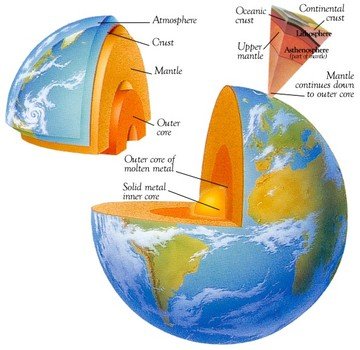
- The part of Earth in the middle of our planet. It has a solid inner core and a liquid outer core. Seismic measurements show that the core is divided into two parts, a "solid" inner core with a radius of ≈1,220 km and a liquid outer core extending beyond it to a radius of ≈3,400 km.
- Crater
- Opening or vent on top of a volcano.

- Crust
- The outermost layer that covers our planet like a shell above the mantle. There are two different types of crust: continental (thicker and less dense) and oceanic (thinner and more dense). The two are different in age and genesis.
- Divergent plate boundary
- Also known as a constructive boundary or an extensional boundary is a linear feature that exists between two plates that are moving away from each other. Divergent boundaries within continents initially produce rifts which eventually become rift valleys. Most active divergent plate boundaries occur between oceanic plates and exist as mid-oceanic ridges

- Dormant volcano
- The volcano that hasn’t erupted in the past 10,000 years, but is expected to erupt again.
